How DSP Powers Every Smart Home Device You Own
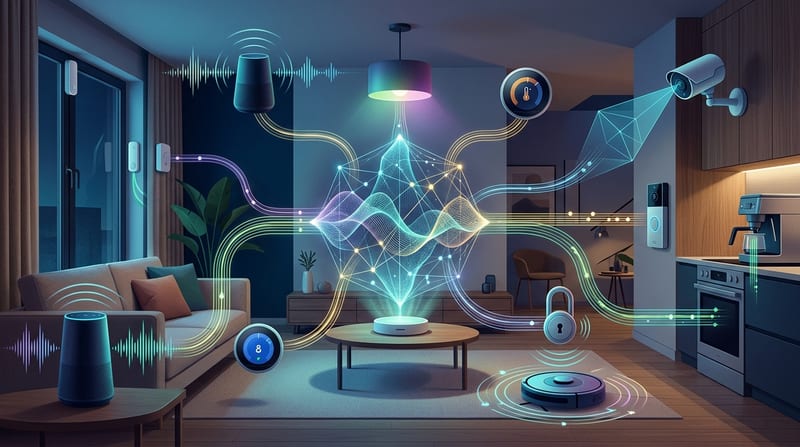
Digital signal processing sits inside every smart home device that handles audio, video, sensor data, or motor control. An Amazon Echo uses DSP to separate your voice from three simultaneous background sources before the wake-word model even runs. A Ring doorbell uses DSP to suppress HVAC fan noise and cancel acoustic echo during two-way conversations. A Nest thermostat uses DSP-class filtering to debounce relay contacts and clean sensor readings. The processing is invisible when it works. It becomes obvious the first time you try to talk to an assistant across a room with a dishwasher running.
This guide walks through where DSP actually lives in consumer smart home gear, what each use case demands from the silicon, and the engineering tradeoffs that separate devices that work in noisy real environments from ones that only work in product demo videos.
What DSP Means in a Smart Home Context
DSP at the device level refers to real-time numerical processing of sampled analog signals: microphone audio, image sensor pixels, motion sensor voltage, or IR detector output. The math is usually some combination of filtering (removing frequencies that carry noise), transforms (FFT to move between time and frequency domains), and adaptive algorithms (echo cancellation, beamforming, automatic gain control) that update their parameters based on the input signal.
The constraint is latency. Audio processing runs at sample rates of 16-48 kHz, which means the DSP has 20-60 microseconds to process each sample before the next one arrives. Video processing at 30 fps gives 33 ms per frame. Smart home devices handle this either in dedicated hardware accelerators inside the SoC or on ARM Cortex-M class cores with DSP instruction extensions. General-purpose application processors would burn too much power for the always-on listening role most smart home devices play.
Audio DSP in Voice Assistants and Smart Speakers
The audio chain inside an Amazon Echo Dot 5th gen or a Google Nest Audio looks roughly like this: seven MEMS microphones arranged in an array, each feeding a 16-bit ADC at 48 kHz. Raw audio streams hit a dedicated audio DSP that runs four separate algorithms in parallel:
- Beamforming. Combines the microphone array signals to create a directional pickup pattern. Sounds coming from the direction of the speaker get amplified by 4-8 dB relative to sounds from other directions. This is why you can be heard across a room even with background noise.
- Acoustic echo cancellation (AEC). When the device plays music and you simultaneously say "stop," the AEC subtracts the known played audio from the microphone input so the wake-word detector only sees your voice. AEC runs an adaptive filter that updates roughly 1000 times per second to track room acoustics.
- Noise suppression. Stationary noise (HVAC hum, refrigerator compressor) gets filtered using a spectral subtraction method. Non-stationary noise (dishwasher, kids, traffic) is harder and where the quality gap between brands shows up.
- Wake-word detection. A small neural network runs continuously on the cleaned audio, watching for "Alexa," "Hey Google," or similar. This model is quantized to INT8 and sized to fit in a few hundred KB of memory. It runs 24/7 so its power budget is usually under 10 mW.
The wake-word network is the only part cloud-connected devices run locally without network dependency. Once triggered, the raw audio (roughly 2-3 seconds of buffered speech) streams to the cloud for the heavier recognition model. That uplink pipeline is where privacy concerns come in, because the microphones have been listening the whole time and a false-positive wake word ships unrelated ambient audio to a remote server.
DSP in Doorbell Cameras
A Ring, Nest, or Eufy doorbell processes two separate signal chains simultaneously: a video chain for the camera and an audio chain for two-way talk. The audio chain has tighter latency constraints because human conversation tolerance is 150-200 ms round-trip before it feels broken.
Doorbell audio DSP handles three problems specific to the outdoor environment:
- Wind noise suppression. Outdoor microphones are wind-beaten. A high-pass filter below 200 Hz removes most wind rumble, and a spectral gate knocks down wind gusts that pass through the high-pass stage.
- Full-duplex echo cancellation. When you speak into your phone and the doorbell speaker plays your voice, the doorbell microphone picks up that played audio and sends it back. Without aggressive AEC, you hear yourself on a half-second delay. Residential acoustics plus the doorbell's own speaker-to-microphone coupling make this harder than the indoor Echo problem.
- Compression for cellular uplink. Outdoor doorbells on 4G LTE backhaul must compress the audio to 32 kbps or below without dropping speech intelligibility. Opus codec at 24-32 kbps is the current standard, and the DSP stage conditions the input signal (compressing dynamics, rolling off extreme frequencies) to give the codec cleaner data to work with.
The video chain runs on a separate hardware pipeline: Bayer demosaicing, noise reduction, HDR tone mapping, H.265 encoding. Each stage must complete within the 33 ms frame budget at 30 fps. The ISP pipeline lives inside the main SoC (Ambarella CV-series on premium models, HiSilicon on budget) and uses dedicated hardware, not the CPU.
Sensor Signal Conditioning in Smart Thermostats and Detectors
DSP in a smart thermostat is unglamorous but critical. A 12-bit ADC sampling a temperature sensor at 1 Hz produces a noisy raw signal with ±0.3 °C jitter. A simple moving-average filter smooths that to ±0.05 °C, which is what feeds the PID control loop. Without the filter, the PID loop reacts to sensor noise instead of actual temperature changes and short-cycles the HVAC compressor.
Humidity sensor output follows the same pattern. The raw DHT22 or SHT31 reading jumps around by 1-2% even in a stable environment. A first-order IIR low-pass filter with a 60-second time constant kills the jitter without adding noticeable latency to the user experience.
Smoke detectors run a more demanding DSP workload: photoelectric and ionization sensors sample at 1-10 Hz, and the firmware discriminates between alarm-worthy patterns (steady obscuration or ionization drop) and nuisance patterns (cooking steam, dust). Modern detectors add a microphone to discriminate T3 vs T4 fire alarm horn patterns from neighboring apartments, which requires FFT-based pattern matching that runs on a Cortex-M0+ at microwatts.
Motion sensors built around PIR use analog front-end filtering (2-step RC high-pass and low-pass at 0.3 Hz and 3 Hz) to reject stationary IR sources and slow thermal drift while preserving the 1-10 Hz signal from a human walking through the detection zone. This is technically analog signal processing, but the modern implementation uses a tiny MCU with a built-in ADC to do the filtering in software, which makes it easier to tune detection sensitivity without swapping components.
Hardware That Carries the DSP Workload
Three chip families cover most of the smart home DSP workload in 2026:
- ARM Cortex-M4 and M7 with DSP instruction extensions and hardware FPU. These sit in thermostats, motion sensors, smoke alarms, and low-power IoT nodes. Typical power is 100-300 μW/MHz, which is low enough to run on a coin cell for years in some applications.
- ARM Cortex-A-class application processors with integrated audio DSP blocks. Amazon's AZ1/AZ2 silicon in the Echo line, Apple's custom SoC in HomePod, and Google's silicon in Nest devices all follow this pattern. The general-purpose cores run the main OS while a dedicated DSP block handles always-on audio.
- Camera SoCs from Ambarella, HiSilicon, and Novatek with dedicated ISP pipelines and hardware H.264/H.265 encoders. Ambarella CV25 and CV28 dominate the premium consumer camera segment because the ISP quality and power efficiency outpace general-purpose alternatives at comparable price.
ESP32-S3 deserves a specific mention for the mid-range. It includes a vector instruction unit that accelerates multiply-accumulate operations, which matters for the small ML inference workloads increasingly shipping at the edge. A 512-point FFT on ESP32-S3 using the vector unit completes in roughly 50 microseconds, which is fast enough for real-time audio feature extraction on a $3 chip.
The Gap Between Spec Sheets and Real Performance
Two smart speakers with the same DSP chip can sound dramatically different. The chip is necessary but not sufficient. What separates the $50 unit from the $200 unit is:
- Microphone selection and mechanical placement. A $0.10 MEMS microphone in a poorly-designed port sounds noticeably worse than a $1.50 microphone in a ported enclosure with proper wind screens.
- Firmware tuning. AEC parameters, beamforming weights, and noise suppression thresholds are all tunable. Premium brands spend engineering time tuning for specific use cases (kitchen, bedroom, noisy office). Budget brands ship the reference tuning from the chip vendor.
- Room adaptation. High-end smart speakers run room-calibration algorithms at setup that measure acoustic reflections and adjust the DSP to compensate. Budget units do not, which is why a budget speaker sounds fine in a furnished living room and terrible in a tiled bathroom.
This is also why reviews focused on the chipset or TOPS rating miss the point. The silicon defines the ceiling. The firmware, microphones, and acoustic design define whether the product reaches that ceiling.
Failure Modes You Only Notice Later
Wake-word false positives are the most visible DSP failure. An Echo that triggers on TV dialogue or a neighbor's voice through thin walls is usually miscalibrated at the noise suppression stage, not the wake-word model itself. The fix is typically a firmware update that adjusts suppression thresholds, but it can take manufacturers months to ship that update.
Acoustic echo leakage on doorbell two-way talk is the second common failure. When you hear yourself on a half-second delay, the AEC adaptive filter has lost convergence. This happens in specific acoustic conditions (tile floors, high ceilings, glass walls nearby) that the filter was not tuned against. There is rarely a user-side fix other than adjusting the doorbell mounting location.
Sensor drift in smoke and CO detectors accumulates over years. The DSP can compensate for gradual sensor aging up to a point, but most devices end up replaced at the 10-year mark because the math cannot hide the aging any longer.
What This Means for Buyers
DSP decides whether a smart home device is usable in noisy, real-world conditions. The spec sheet rarely says anything useful about DSP quality because the metric that matters (subjective listening quality, recognition accuracy in noise) is hard to standardize. Test devices in the environment you will actually use them. Every premium smart home vendor provides a return window, and you should use it if the device falls apart the first time you run the vacuum with it listening.
The silicon keeps getting cheaper and more capable. The gap between devices that excel at real-world DSP and ones that fail at it will not close through silicon alone. Firmware quality and acoustic design will continue to separate the category's top tier from its bottom.
Related: Digital Filter Design | How AI Chips Evolved From Basic DSP Processors